Hotel AI Must Earn Guest Trust

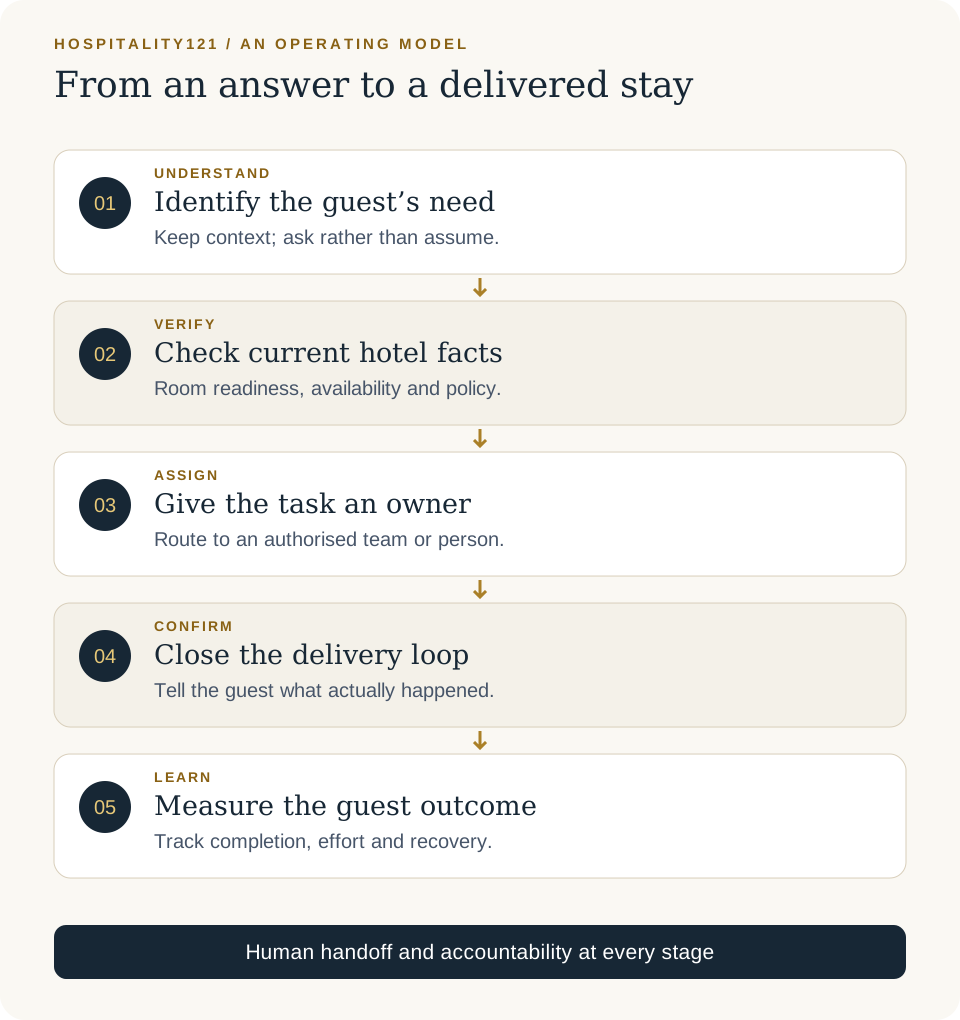
An operating model proposed by Abdellah Ait Ibour. A response becomes service only when someone owns delivery.
A guest asks whether an early arrival is possible. An AI assistant replies immediately, in the right language and with a reassuring tone. Upstairs, the room has not been cleaned. Reception knows nothing about the conversation.
That hypothetical exchange captures the challenge I see at the centre of hotel AI: a convincing answer can create a commitment before the hotel has the capacity to honour it.
My view is that hospitality should judge AI by the quality of the stay it helps deliver. Faster answers matter. So do accurate information, a clear owner for every request and an easy route to a person. The advantage comes when those pieces work together.
Hospitality delivers its product in person
A software company can often improve a digital experience by changing the interface or removing a step. Hotels must also coordinate rooms, people, maintenance, food, transport and time. A promise made on a screen has to survive contact with a physical building and a working shift.
Hospitality is not alone in facing these constraints; healthcare, transport and retail services have them too. What distinguishes a hotel stay is their concentration in one experience. The same guest may need speed at arrival, privacy during the afternoon and patient attention when something goes wrong that evening.
That makes the hotel an unusually demanding environment for automation. One guest wants to bypass reception. Another wants someone to explain the neighbourhood. Neither preference should become a permanent label applied to every future interaction.
For a technology leader, this changes the design brief. The task is to connect digital convenience to dependable service, while preserving the guest's ability to choose how they are helped.
What the 2026 evidence actually tells us
In research released on 7 October 2026, Mews reported that 89% of surveyed travellers preferred either a combination of AI and human service or AI working on repetitive tasks behind the scenes. 75% said good hospitality depends on human staff. The survey covered 3,250 travellers across eight countries and was conducted in July. These are vendor-published survey findings about preferences, not proof of improved hotel performance. Mews guest research.
The operational picture deserves equal attention. The Fall 2026 State of Hotel AI study, published on 29 September, surveyed 107 hotel-company leaders during August and September. It reported that 42% felt confident about their data readiness. Change management, data quality and integration were cited as barriers by 35%, 34% and 29%, respectively. This is a small, self-reported leadership sample; it should not be treated as a census of the hotel industry. Study and methodology.
Hospitality trade publications are examining the same tension. In its 16 October 2026 contributed column, Hotel Management discussed deliberate decisions about AI's role, citing Mews' earlier hotelier survey. eHotelier covered that research on 19 May, including the finding that 59% of surveyed hoteliers wanted the welcome and check-in to remain human-led. The underlying survey covered more than 500 properties between December 2025 and March 2026. This is one survey reported through multiple outlets, not several independent confirmations. Hotel Management, eHotelier, Mews primary release.
My interpretation is that the constraint is often operational readiness. A more capable model cannot, by itself, reconcile contradictory opening hours or decide which team owns an unanswered request.
Hotel groups are making the opportunity concrete
Hilton announced its AI Planner on 10 March 2026, describing a beta digital concierge for conversational destination and hotel discovery. Its stated purpose includes helping travellers compare properties and explore amenities. That is a useful example of reducing the effort involved in choosing a stay; the announcement does not establish an independently measured increase in guest satisfaction or conversion. Hilton announcement.
Accor's 24 September 2026 announcement of ALL Concierge describes conversational hotel discovery, property information and access to human support for complex requests. Its FAQ specifies availability on ALL.com in 11 languages, while app availability was more limited at that point. It also lists further capabilities as planned, so they should not all be presented as already delivered. These are Accor's descriptions of its own product, rather than independent evidence of service outcomes. Accor announcement and availability details.
Together, these examples show where hotel groups are investing: helping guests express what they need and navigate a complex offering. For an individual property, the next question is whether the information and service behind that conversation are equally dependable.
Build a service loop the team can trust
The diagram above sets out my proposed operating model. Start by understanding the request, verify the facts, assign an owner, confirm delivery and learn from the result. A person must be able to take over throughout. This is a recommendation, not a claim that a particular hotel has achieved these results.
Consider a guest requesting a quiet room before arrival. AI can help identify the request and present it consistently to the team. The hotel still needs an agreed meaning for “quiet”, an accurate view of available rooms and a way to avoid promising something it cannot guarantee. Confirmation should reflect what has actually been assigned.
The same principle applies to a late checkout. A useful system checks availability and policy before communicating a confirmed decision. When approval is required, it should make the pending status clear. The guest should never have to discover at the desk that an apparently settled request was only a suggestion.
| Guest moment | Potential AI contribution | Operational condition | What to measure |
|---|---|---|---|
| Before arrival | Organise preferences and explain options | Current property information and realistic availability | Corrections, repeated questions and unresolved requests |
| During the stay | Translate and route a service request | A responsible department and a visible task status | Time to completion and guest follow-up effort |
| When service fails | Summarise the issue for the next employee | Clear human ownership and authority to resolve it | Repeated explanations and time to resolution |
| At departure | Prepare an explanation of charges | Verified billing information and staff review where needed | Disputes, corrections and unresolved issues |
These are suggested measures, not published performance results. Their purpose is to make the guest benefit observable. A quick response that leaves the request unfinished should not count as success.
Personalisation needs boundaries
A hotel can be attentive without collecting every detail of a guest's life. Start with information needed for the service, explain how it is used and respect a guest's decision to decline optional personalisation.
Access also matters. A tool that answers breakfast questions does not automatically need permission to change reservations, issue refunds or expose another guest's information. Give each workflow the access it needs and keep consequential actions reviewable.
For sensitive requests, the system should help a responsible employee respond. It should avoid inventing an assurance about accessibility, safety or an allergy because a fluent answer sounds helpful. The hotel remains accountable for what it communicates.
Invest in the experience you want to improve
I would start a hotel AI programme with one recurring source of guest effort, such as a request being passed between departments. Establish how the process works today, agree the desired outcome and test the new workflow with the employees who will use it.
Review actual conversations and completed tasks before expanding. Include people who prefer a conversation to a screen, guests using different languages and staff working the busiest shifts. Test what happens when information is missing or a system is unavailable. A fallback needs to work when the hotel is under pressure.
Commercial evaluation should include integration, training, supervision and the work of correcting mistakes. Time saved is valuable when it creates capacity the hotel can use. It becomes a guest-experience benefit only when that capacity changes the service delivered.
That is where I believe hospitality can gain something distinctive from AI: a hotel that remembers the right detail, coordinates the right people and follows through with less effort from the guest. The technology earns its place through that follow-through.
For related coverage, explore AI in the guest experience, hotel technology and hotel operations.
Continue the conversation
Follow Abdellah Ait Ibour on LinkedIn and X for more discussion of hospitality technology and guest experience.
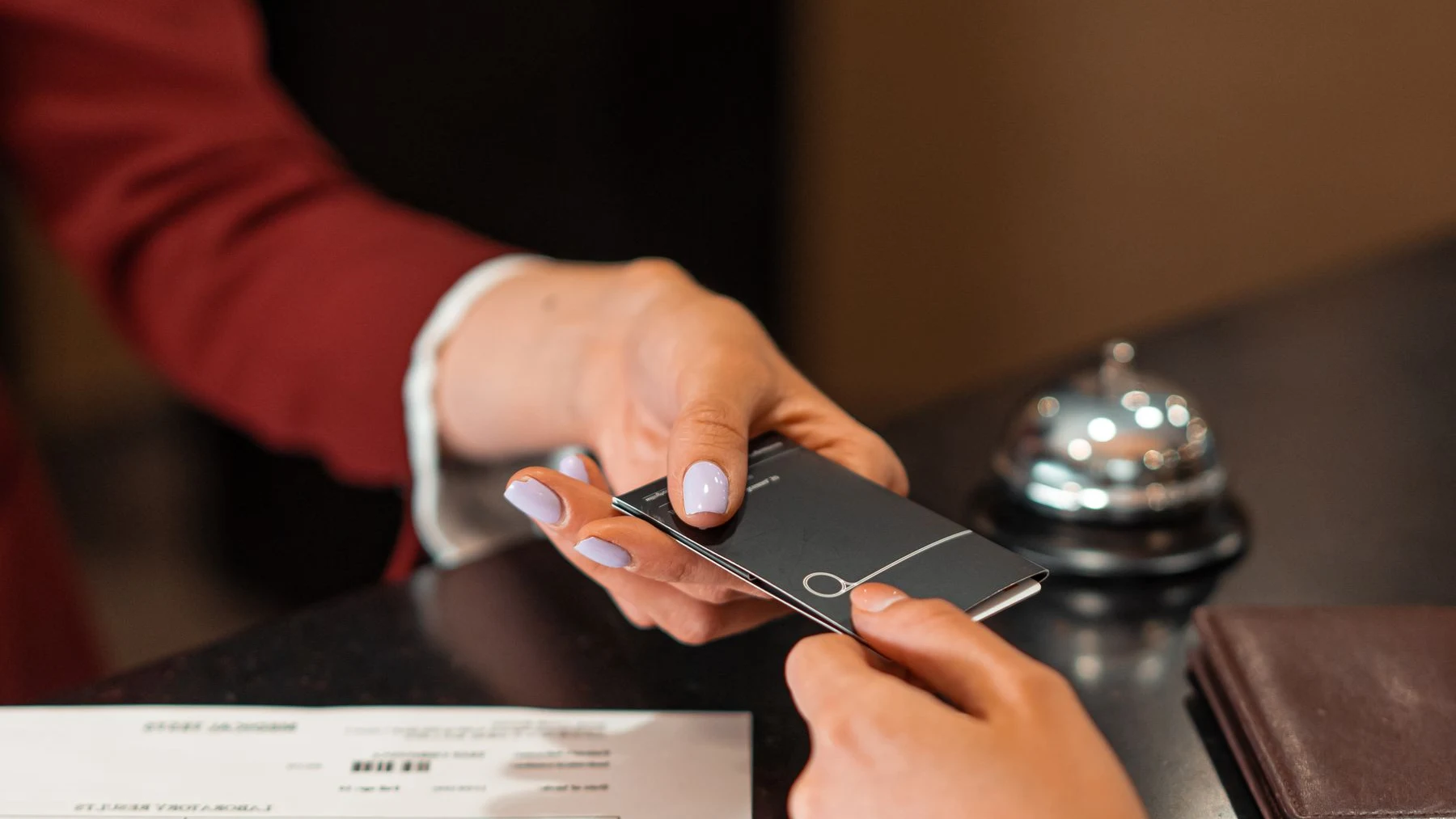
Editorial note: Original commentary prepared with AI assistance and automated source checks. References were published in 2026 and checked on 30 October 2026. The article carries the author's requested editorial date of 29 October 2026. The photograph is reference stock imagery; the service-loop diagram is an original proposed framework. Survey findings and hotel-group product statements are attributed above, with no claim of independent operational testing.
If AI could give your team back one part of the guest journey, where would you invest that time to make the stay feel more personal?
About the author
Abdellah Ait IbourAbdellah Ait Ibour writes about hospitality technology, AI and the operational decisions that shape the guest experience.